Backgammon
Play now
Sudoku is a logic-based number puzzle played on a 9×9 grid. This guide covers the rules, how to read the board and how to finish a puzzle.
Sudoku is popular because it requires no guessing, rewards careful thinking, and can be enjoyed at any pace, from casual play to serious problem-solving.
The goal of Sudoku is to fill the grid so that:
A completed Sudoku puzzle satisfies all three conditions at the same time.
Each number you place must follow the row, column, and box rules.
A number can be placed in a cell only if:
If any of these rules are broken, the move is invalid.
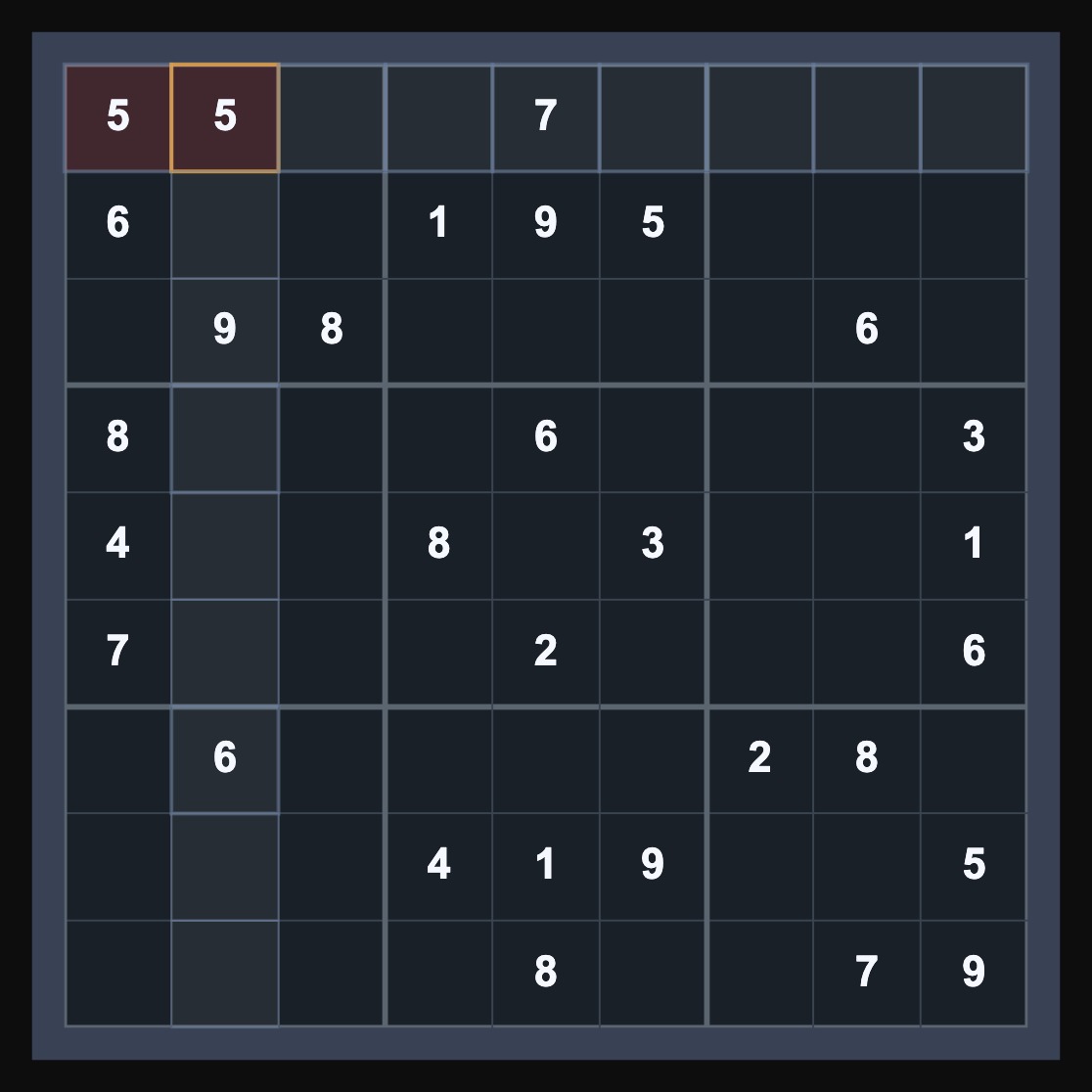
The diagram below shows a Sudoku puzzle partway through solving. The highlighted cell is currently selected, and some cells are marked as invalid because they break Sudoku rules.
In this example, the selected cell causes a row conflict: there are two 5s in the top row.
If you see invalid cells, correct them before continuing. Sudoku is easiest when you catch mistakes early.
A row conflict happens when the same number appears more than once in a single row.
A column conflict happens when the same number appears more than once in a single column.
A box conflict happens when the same number appears more than once in a 3×3 box.
Many beginner mistakes happen by overlooking the box rule, especially in the center boxes.
These techniques are enough to solve most easy and medium Sudoku puzzles.
Look at a row, column, or box and identify which numbers are missing. Then check where those numbers can legally fit.
For an empty cell, eliminate numbers that already appear in the same row, column, or box. The remaining numbers are possible candidates.
If a cell has only one possible number that can fit without breaking the rules, that number must go in that cell.
If a number can only fit in one cell within a row, column, or box, that cell must contain that number.
Sudoku difficulty labels vary by source, but they usually mean:
A Sudoku puzzle is complete when:
Many published puzzles are also designed to have exactly one valid solution.
Sudoku is a game of logic and careful observation. Every move must respect row, column, and box constraints. When a mistake creates an invalid placement, correcting it early makes the puzzle much easier to solve. With practice, scanning and simple elimination techniques become second nature.