Backgammon
Play now
Truco is the classic bluffing card game of Argentina and Uruguay — three cards a hand, a wild non-sequential ranking, and two betting mini-games layered on top. Call Truco to raise the stakes on the cards you're holding, or Envido to bet on their combined value, all before your opponent calls your bluff.
Play single-player against a bot that knows how to bluff back, or invite a friend for the real thing.
Truco is a race to 15 points. String together enough won rounds — worth more once you've raised the stakes — and you take the match.
Every round is worth 1 point by default. Either player can raise that value before the round ends by calling Truco: accept the call and the round jumps to 2 points, with two further raises still possible on top of that. A separate side bet, Envido, lets you wager points on the value of the three cards in your hand — independent of who wins the round itself.
Points from Truco calls and points from Envido calls both count toward the same 15-point finish line.
Truco is played with a 40-card Spanish deck: four suits — espadas (swords), bastos (clubs), copas (cups), and oros (coins) — with ten ranks in each: 1 through 7, then 10, 11, and 12. There are no 8s or 9s in a Spanish deck. Every card is identified purely by its rank and suit, like "3 de Basto" or "7 de Oro."
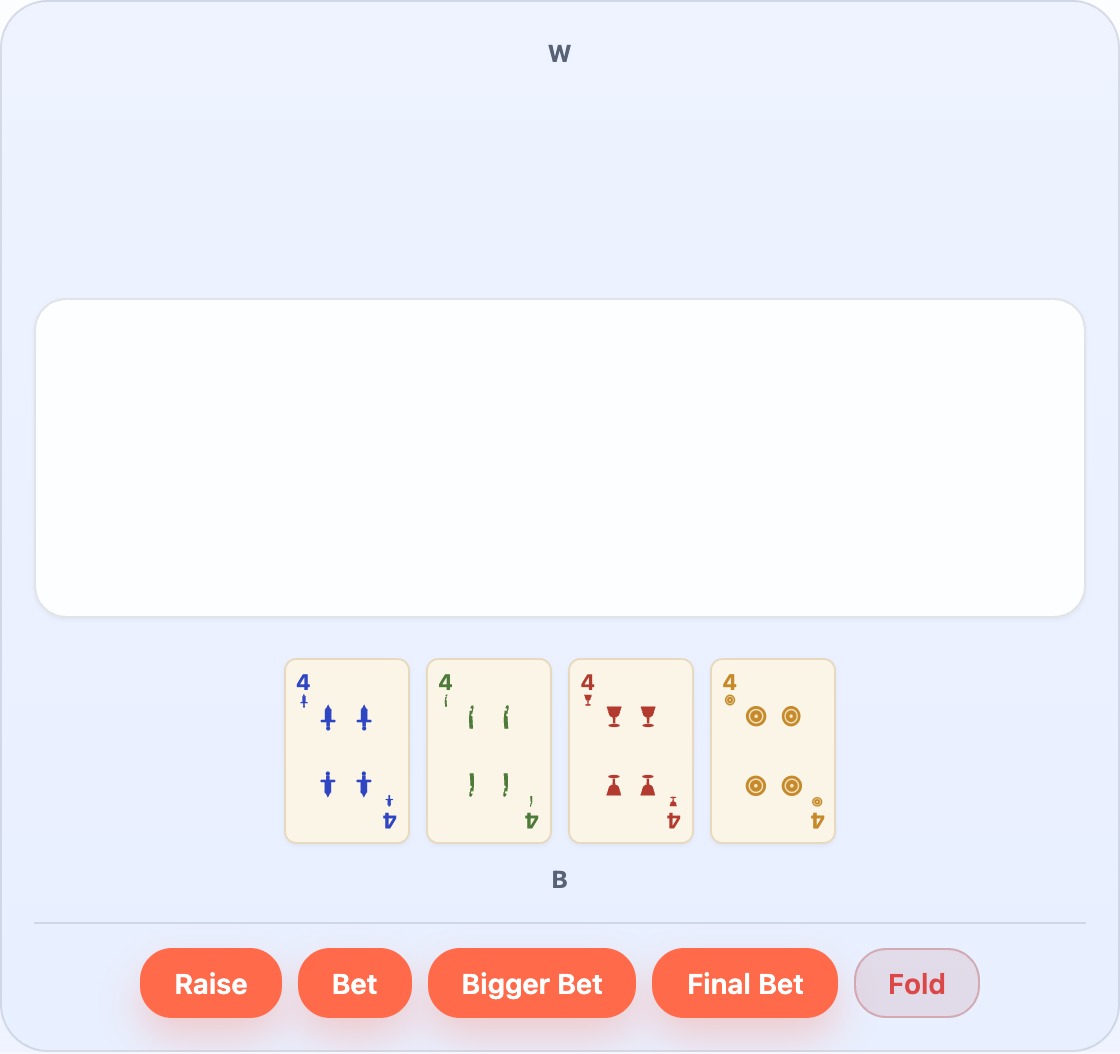
Each suit has its own symbol, repeated in the corner badge and filling the middle of the card. Recognizing these four shapes at a glance is worth doing before anything else — every rule from here on refers to cards by suit name.
Left to right: espadas (swords), bastos (clubs), copas (cups), oros (coins). The same four suits appear on every rank from 1 through 12 — only the illustrated 10s, 11s, and 12s look different from card to card within a suit.
This is the single most important thing to learn before you play: card strength in Truco has almost nothing to do with the printed rank. A handful of specific cards break rank entirely, and a lowly 3 outranks a King. Every one of the 40 cards falls into one of 14 strength tiers, from strongest to weakest:
Cards within the same tier are equal in strength. If both players play a card from the same tier, that trick is a parda — a tie — which we'll cover in Playing Tricks.
These four cards anchor Truco's entire ranking — nothing else in the deck beats any of them. Espada (swords) and Basto (clubs) each have one card that outranks its whole suit, and the two black 7s — Espada and Oro — sit just below.
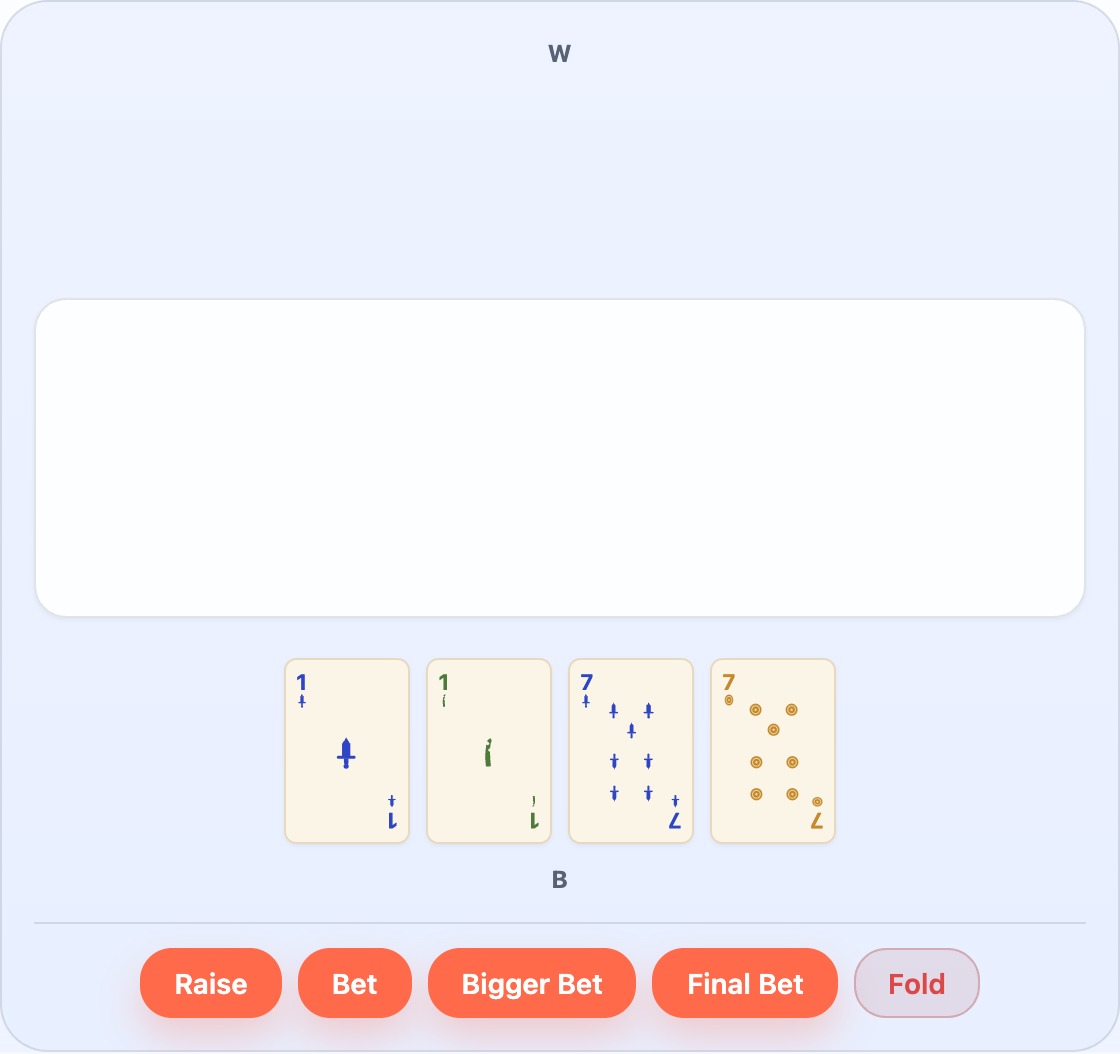
From strongest to weakest: the 1 de Espada, 1 de Basto, 7 de Espada, and 7 de Oro. Every other card in the deck — every 3, every 2, every King — ranks below all four of these.
Each round, both players are dealt 3 cards from the 40-card deck, and play continues until those 3 cards are gone.
One seat holds the Mano — the player who leads the first card of the round and carries one extra privilege: if every single trick in the round ends in a parda, the Mano wins the round outright. Mano alternates every round, so the advantage changes hands each time.
Your 3 cards are visible only to you. Your opponent's hand stays hidden until they play a card face-up.
Player B is Mano this round and leads first. Player W's three cards are dealt too, but stay face-down — a card back is all either player sees of an opponent's hand until it's actually played.
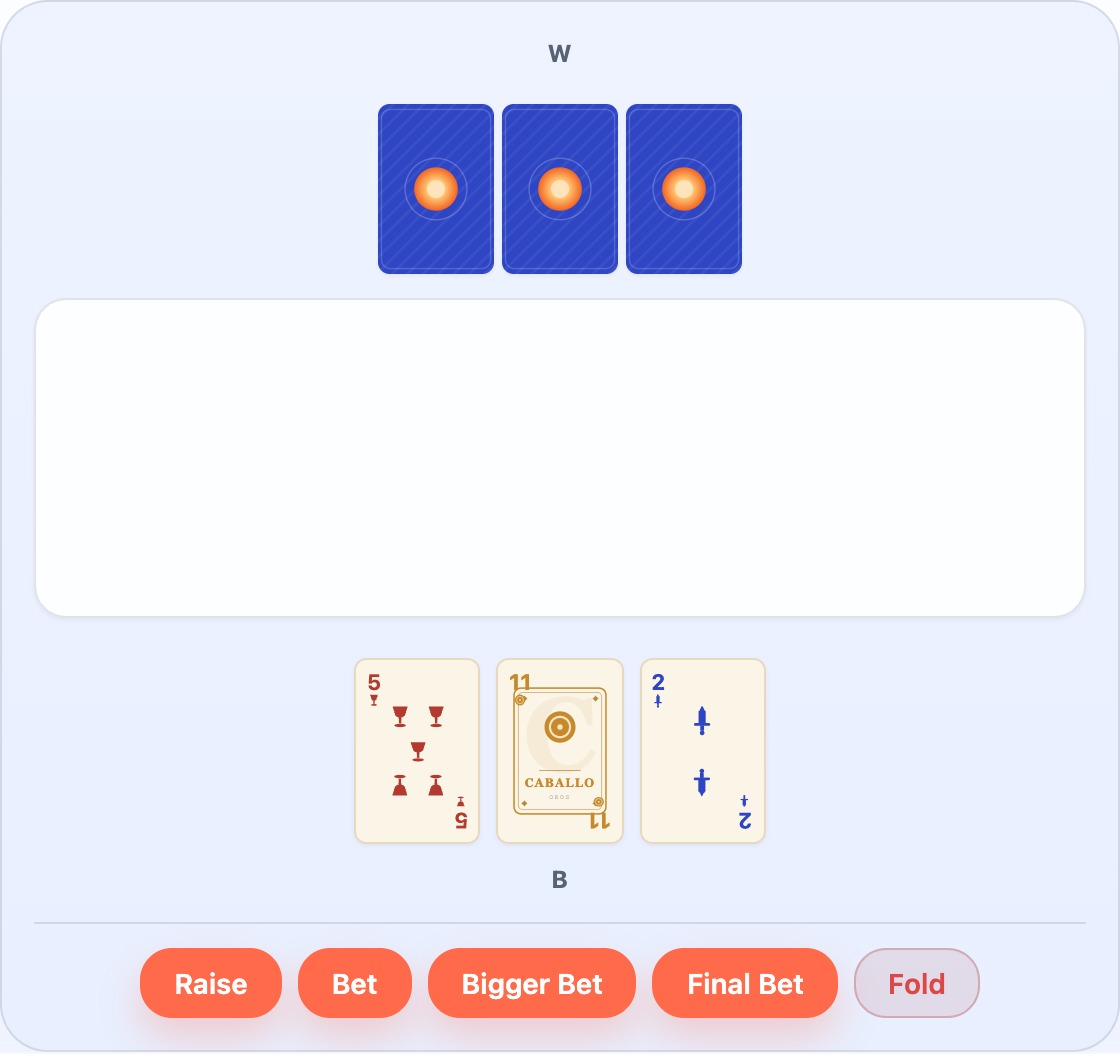
Nobody has played a card yet. From here, B can lead with any of the three, or call Truco or Envido before committing to one.
A round is decided over up to 3 tricks. On your turn, play one card from your hand face-up; once both players have played to the current trick, the higher card wins it. Whoever wins a trick leads the next one.
If both players play cards from the same strength tier — say, two 6s, or two Kings (12s) — the trick is a parda: nobody wins it outright. A parda doesn't cost you the round, but it changes how the remaining tricks are counted:
Both players have led trick 1 with a 3 — one 3 de Espada, one 3 de Oro. Since all four 3s share the same strength tier, this trick is a parda: neither card beats the other.
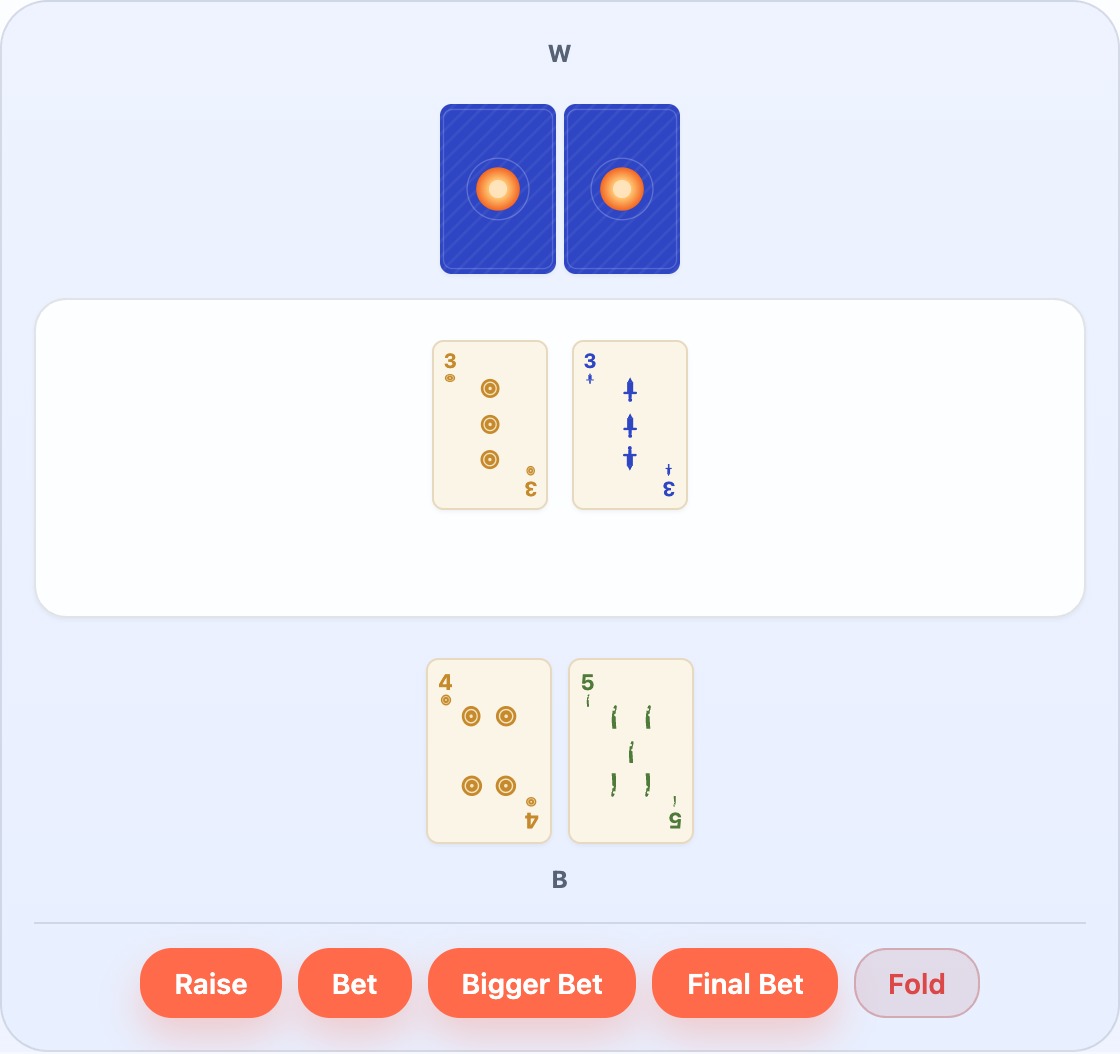
From here, the first player to win a trick outright takes the round — unless every trick ties, in which case the Mano wins by default.
Tricks 1 and 2 both ended in a parda, and now trick 3 — the decider — ties too: two 6s. Nobody won a single trick outright, but Player B was Mano this round, so B takes it anyway.
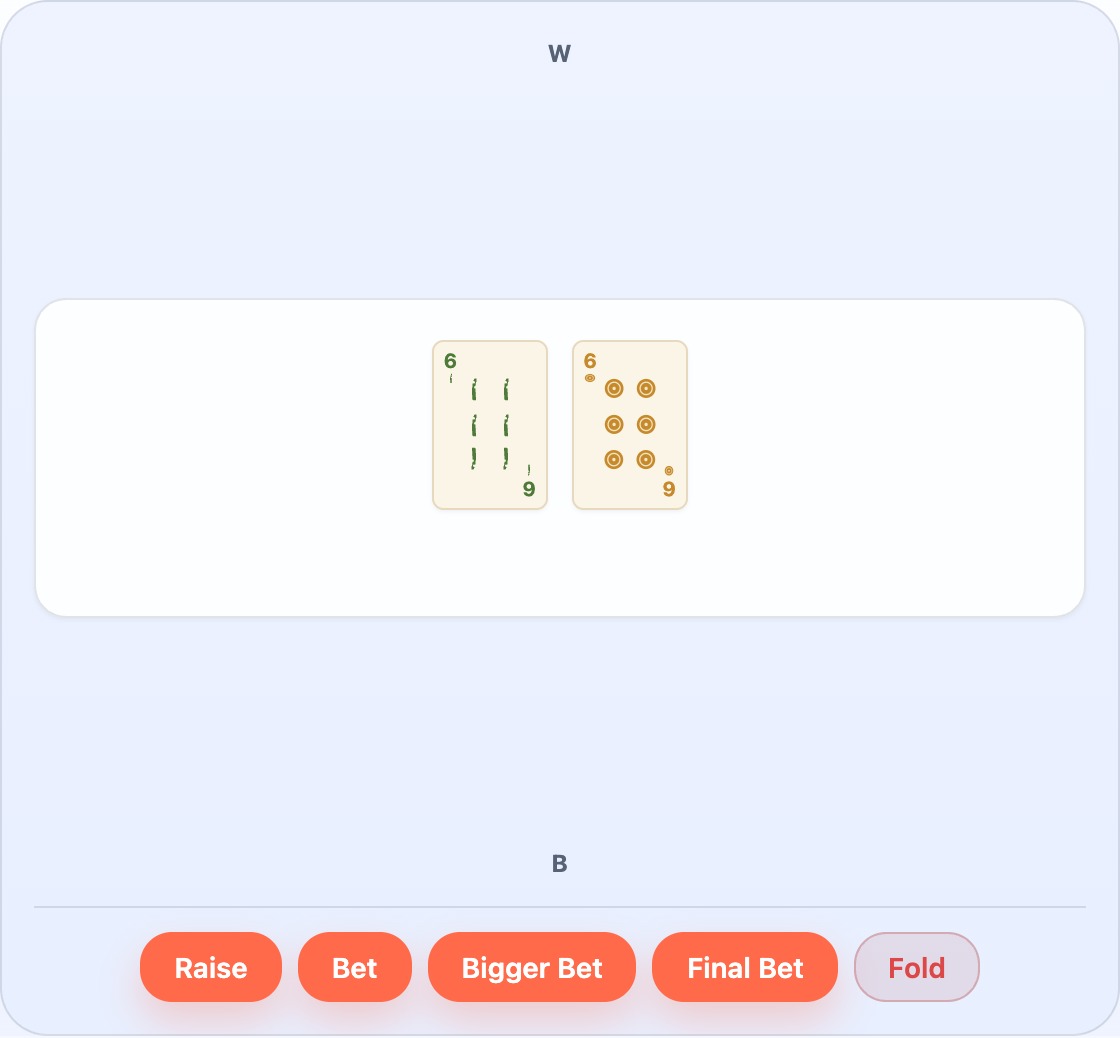
This is the only way to win a round without ever winning a trick — and it's exactly why Mano, which alternates every round, is a real advantage worth tracking.
Anyone can call Truco on their turn to raise the round from its default 1 point up to 2. From there the stakes can climb twice more — Retruco (3 points) and Vale Cuatro (4 points) — each one a fresh escalation on top of the last. Vale Cuatro is the ceiling; once it's on the table, there's nothing left to call but a response.
Only the player who didn't make the pending call can respond to it or escalate it — you can't raise your own call while your opponent hasn't answered yet.
When a Truco call is pending, the other player has a few options:
Player B has called Truco before playing a card. The round's value is still shown as 1 point until Player W answers — accepting would raise it to 2.
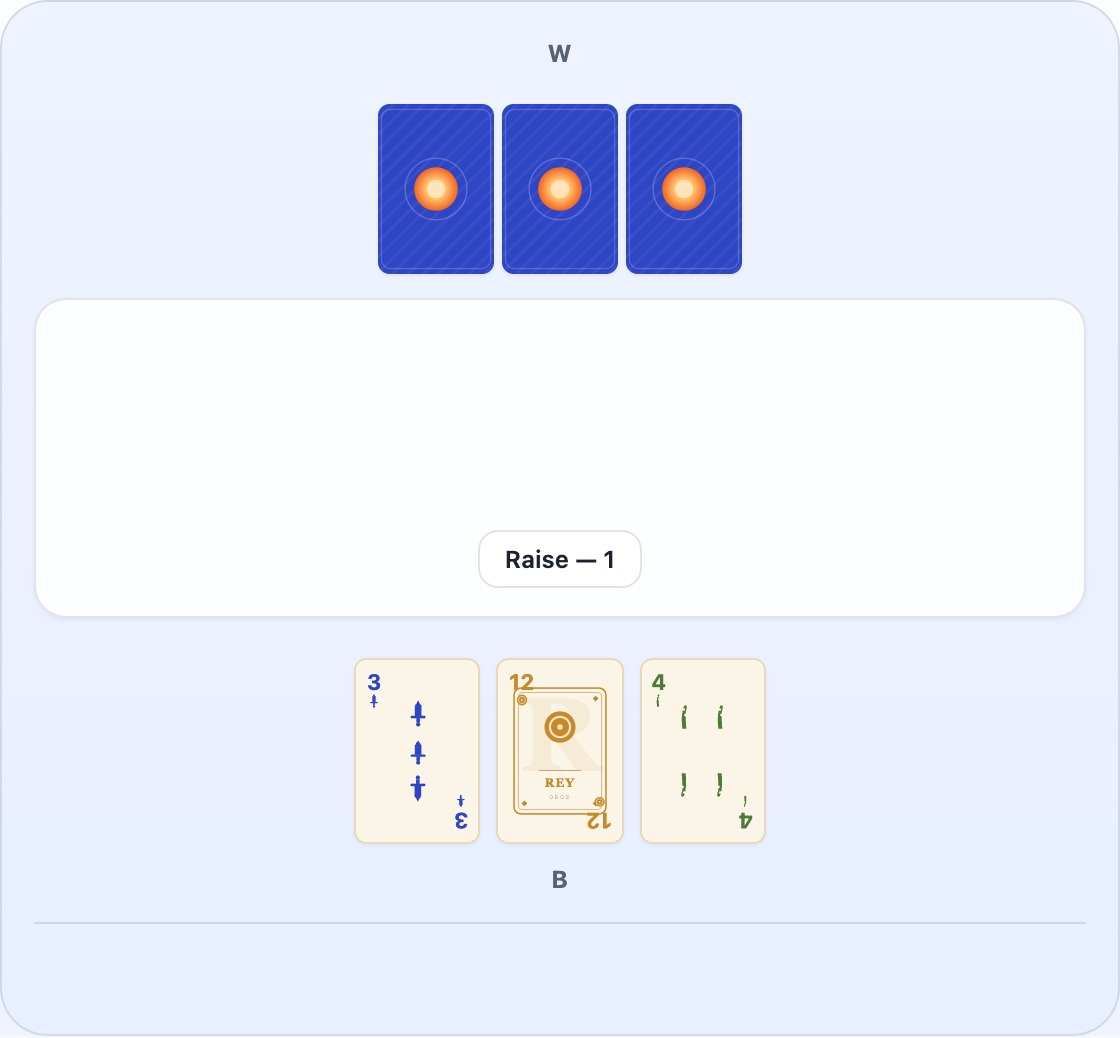
No cards have been played yet — Truco can be called at any point in the round, including before the very first card. Player W's response decides whether the round is worth 1 point or 2.
Envido is a side bet on the strength of your 3-card hand, separate from who wins the round's tricks. It can only be called before the first trick finishes — once trick 1 is decided, the window closes for the rest of the round.
Cards ranked 1 through 7 are worth their face value in pips; 10, 11, and 12 are worth 0. If two of your three cards share a suit, your Envido value is their two pip values added together, plus 20. If no two cards share a suit, your value is just your single highest pip (no +20).
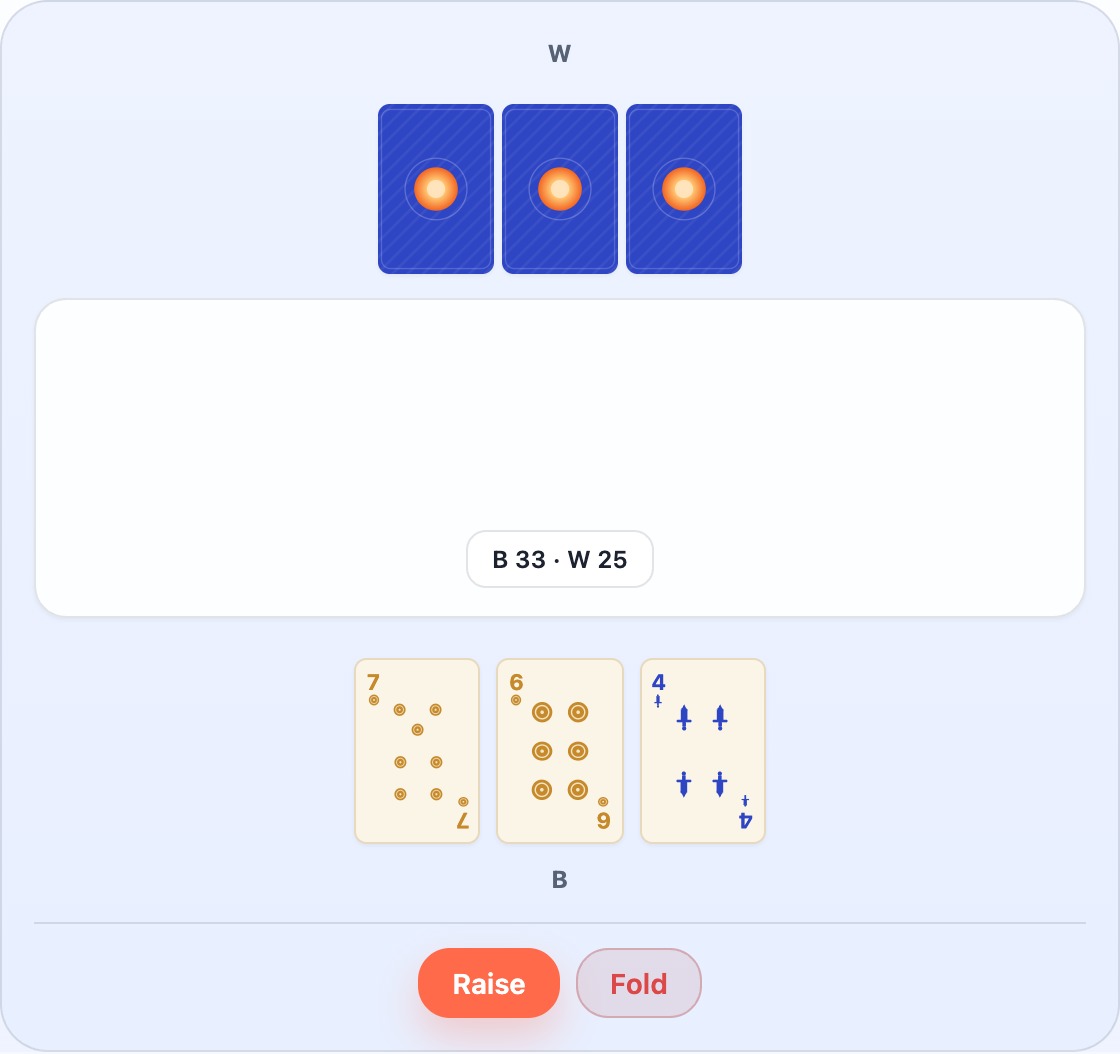
The best possible hand is two cards of the same suit ranked 7 and 6: 7 + 6 + 20 = 33.
Like Truco, Envido can be raised before anyone answers:
Decline any call and your opponent — the caller — collects only the value the chain had already reached before that last raise (minimum 1 point), not the value of the raise you turned down.
If you're on the receiving end of a Truco call, you don't have to answer it right away — you can call Envido instead. The Truco call stays pending and only gets answered after the Envido bet is fully resolved.
Both hands are shown after Quiero was called. Player B holds two Oros — 7 and 6 — for 7 + 6 + 20 = 33, the maximum possible. Player W's two Copas — 5 and 10 — score 5 + 0 + 20 = 25 (the 10 counts as 0 pips). B's higher value wins the Envido and scores the 2 points this plain Envido call was worth.
Player B called Truco and is still waiting for an answer — instead of responding right away, Player W called Envido, which gets fully resolved first. W's espadas 6 and 5 make a matching pair (6 + 5 + 20 = 31); B's three different suits have no pair, so B's value is just the highest pip, a 7. W wins the Envido and scores its 2 points — only now does W have to answer B's still-pending Truco call.
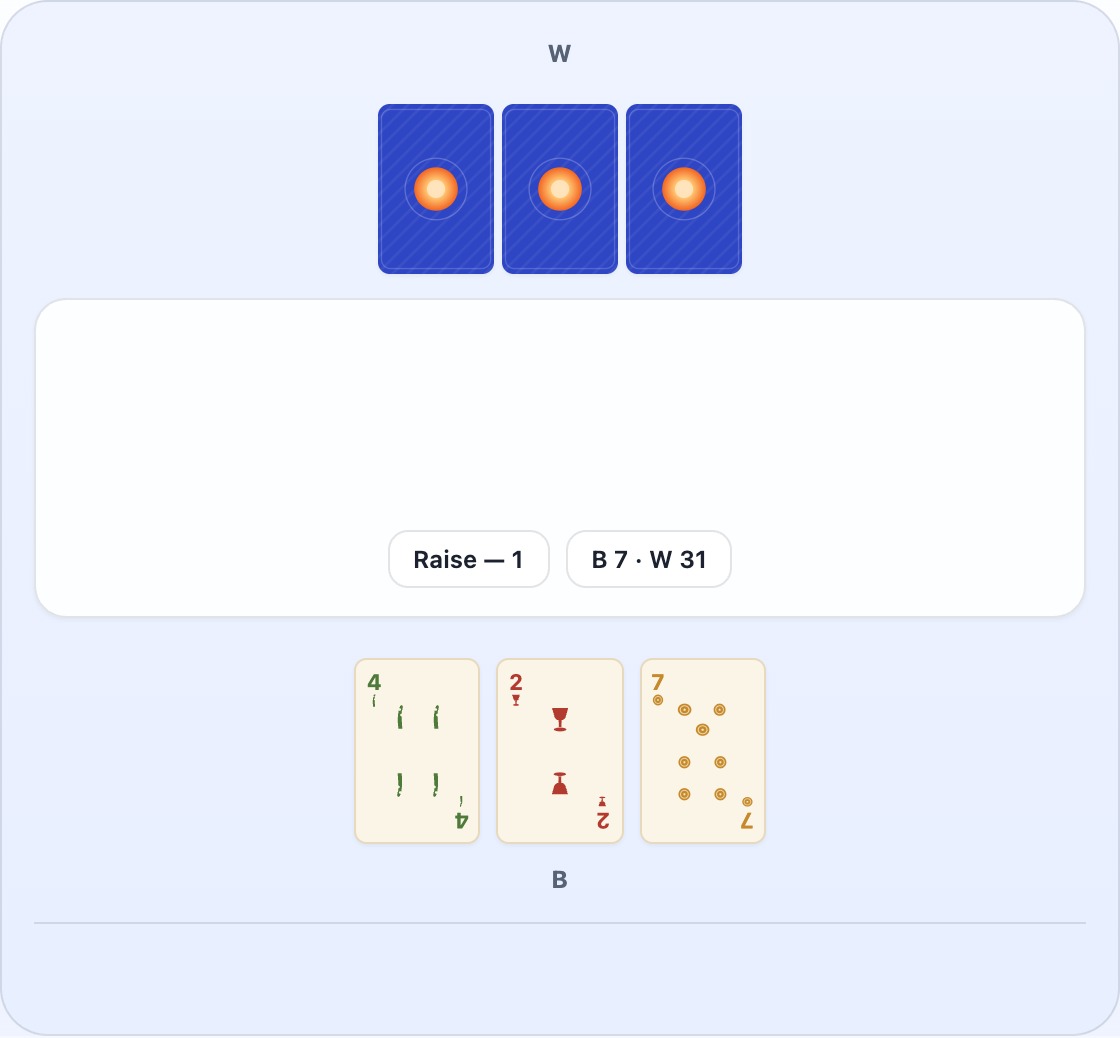
Both status pills show at once — the round's value is still just 1 point pending B's Truco, and W's Envido is already settled. B still has to answer Quiero, No Quiero, or escalate to Retruco before the round can continue.
Irse al Mazo — literally "to go to the deck" — means throwing your hand in and conceding the round immediately, without playing it out.
When you fold, your opponent is awarded whatever the round is currently worth: 1 point if no Truco call has been accepted yet, or the escalated value (2, 3, or 4) if one has. A new round is then dealt.
You can fold on your own turn instead of playing a card, or use it as your answer to a pending Truco or Envido call instead of accepting, declining, or escalating. The caller of a pending call can't fold their own call away, but the player facing it always can.
Folding trades a small, certain loss for avoiding a larger one. It's usually worth considering when:
Folding too often is its own mistake — your opponent will start calling Truco on weak hands, knowing you'll bail. A believable mix of standing your ground and folding is what makes the bluff on both sides work.
Truco is played to 15 points. Both Truco calls and Envido calls add to the same running score, and the moment either player reaches 15, the match ends immediately — even mid-round.
Points come from a handful of sources:
Because Envido always resolves before trick 1 finishes, it's possible to win the match on an Envido call alone — a big Falta Envido can end things before a single trick has even been decided that round.
Truco rewards reading your opponent as much as reading your cards. A few habits go a long way while you're learning.
Calling Truco or Envido puts pressure on your opponent to make a decision under uncertainty — that pressure has value even when your hand isn't great. But calling with nothing to back it up, over and over, trains your opponent to call your bluff. Save your loudest calls for hands that are genuinely strong, and mix in the occasional bluff only once your opponent has seen you make good on a few real ones.
Remember the ranking isn't sequential — a hand with a 3 and a 2 in it is much stronger than it looks at first glance, since both outrank every 10, 11, and 12 in the deck (see The Deck and Ranking). New players often undervalue small numbers and overvalue face cards.
A quick No Quiero or an immediate fold tells you your opponent's hand is weak this round — it doesn't mean their next hand will be too. Use a cautious opponent's pattern so far as a weak signal, not a certainty, and watch for players who start folding faster specifically after you've won a couple of calls in a row — a sign they've started reading you.
Before you call Envido, add up your hand: any two cards of the same suit are worth their pip total plus 20 (cards above 7 count as 0 pips), and a hand with no matching suit is worth just its highest card. A hand worth 27 or more is usually strong enough to call confidently; anything under 20 is often worth staying quiet on unless you're specifically bluffing.
Envido is decided before the first trick finishes, so make that call — or decline one — before you've committed to how you'll play the tricks that follow.