Backgammon
Play now
Dominoes is a tile-matching race played with the double-six set: 28 tiles, each half showing zero to six pips. Draw a hand, then take turns laying tiles end to end so the pips match one of the line's two open ends — can't go, and you draw from the boneyard until you can. Shed every tile first and you score all the pips still sitting in your opponents' hands; first to 100 wins the match.
New to it? The guide below covers the deal, the forced opening, doubles and the boneyard, and what happens when nobody can move — about five minutes, start to finish. Play solo against bots while it clicks, or send a link and fill the table with friends.
Empty your hand before anyone else does, and the round is yours.
Every tile you play brings you a step closer to going out. The instant your last tile hits the line, the round ends and you score every pip still sitting in your opponents' hands — their loss becomes your points. A match runs to 100 points across as many rounds as it takes; reaching 100 first wins the match, not any single round.
Not every round ends that way, though. Sometimes nobody at the table can play and the boneyard has nothing left to offer — the round is blocked instead, and the lightest hand wins it, not the emptiest. The Blocked Rounds and Scoring sections cover exactly how those points are counted.
Playboard deals from a double-six set: 28 tiles in total, one for every combination of two numbers from 0 to 6, including each number paired with itself.
Each tile is split into two halves, and every half shows a pip count from blank (0) to six. A tile where both halves match — 4-4, say — is a double; every other tile pairs two different numbers, like 6-3. Doubles matter more than they look: one of them decides who opens the round, and once one is played it lies crosswise across the line rather than end to end — more on that in Doubles and the Spinner.
The total pips on a tile is its value, and that value is exactly what an opponent's tiles cost you if you're still holding them when someone goes out — so a hand full of heavy tiles isn't just harder to place, it's expensive to be caught holding.
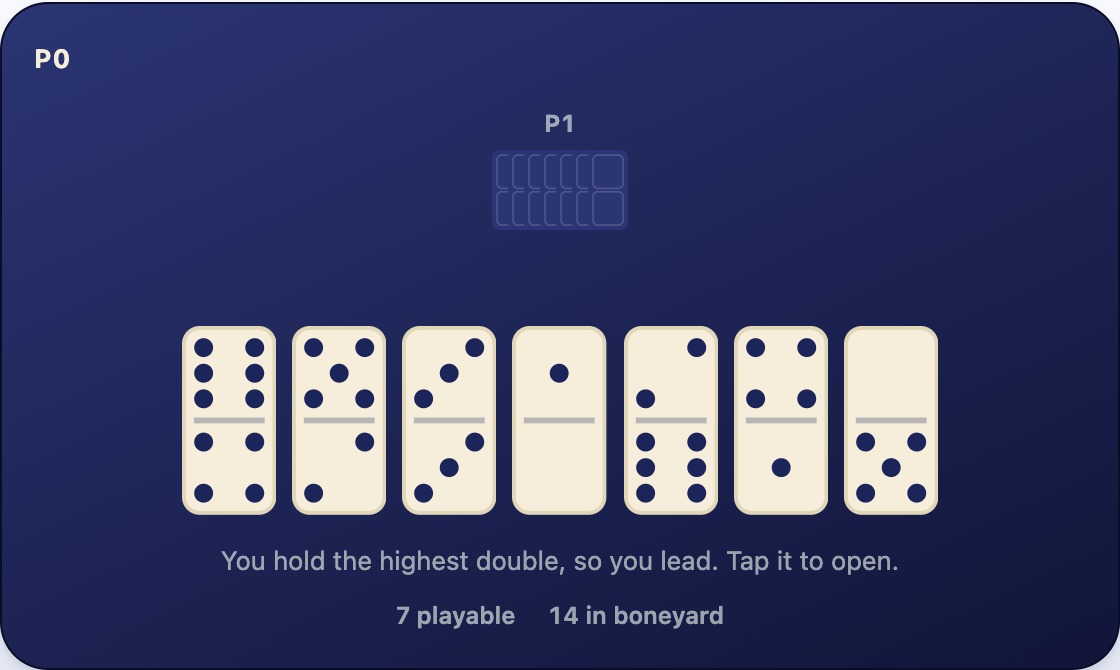
Seven tiles, dealt and fanned out. One of them — 3-3 — is a double: the same number on both halves.
Everyone draws their hand from the shuffled 28 tiles before a round starts. Two players get 7 tiles each; three or four players get 5 each. Whatever's left over goes face down as the boneyard — the pile you'll draw from during play.
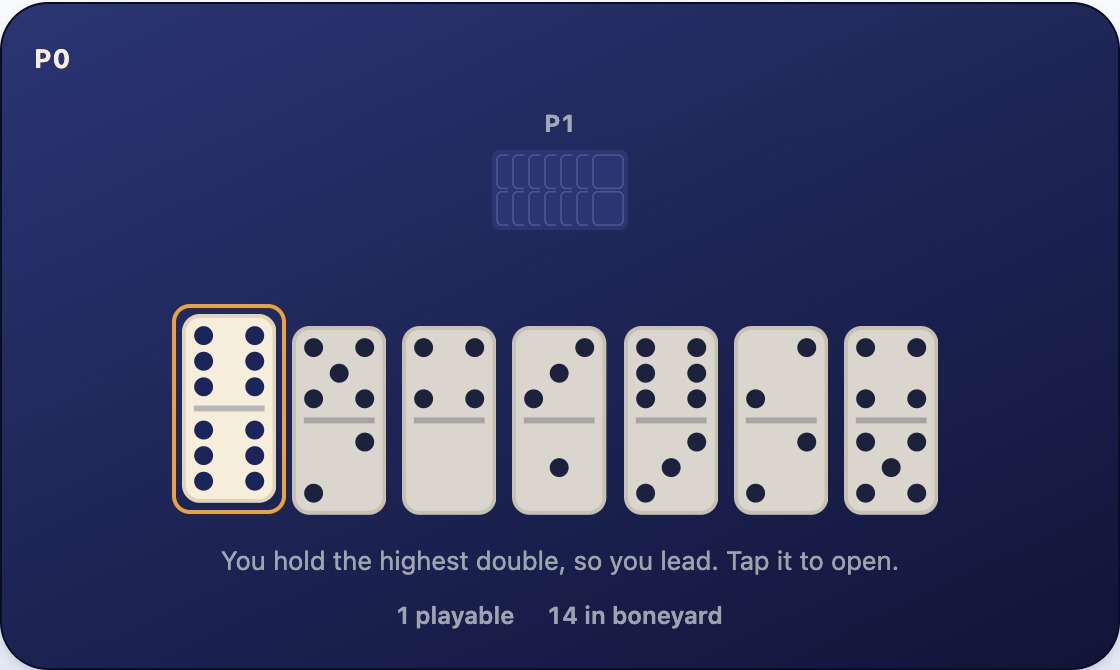
Whoever holds the highest double dealt opens the round, and they have no choice about it: that tile is the only legal first play. Nobody dealt a double at all? Then the heaviest tile at the table — the one with the highest pip total — opens instead.
You're dealt 6-6, the highest possible double. The line is still empty, so it's the only tile you're allowed to play — everything else in your hand has to wait.
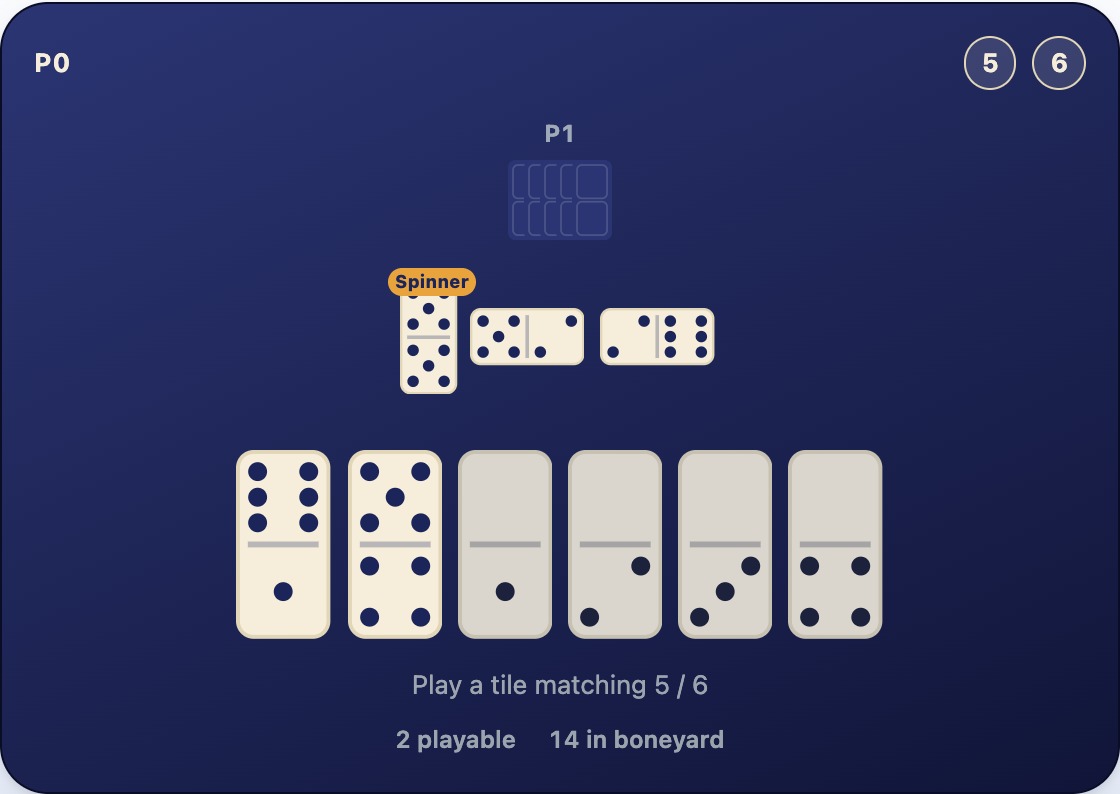
On your turn, play a tile from your hand against either open end of the line — the pip count on one half of your tile has to match the number showing at that end. The other half can be anything; once it's down, that half becomes the new open end.
Both ends are live at all times, and they're usually different numbers, so you're rarely stuck for just one reason. If nothing in your hand matches either end, you don't get to skip straight to passing — see The Boneyard for what happens next.
The line reads 5 on the left, 6 on the right. Your 5-4 fits the left end, your 6-1 fits the right — either is a legal play, and the rest of your hand is dead until one of those numbers comes back into play.
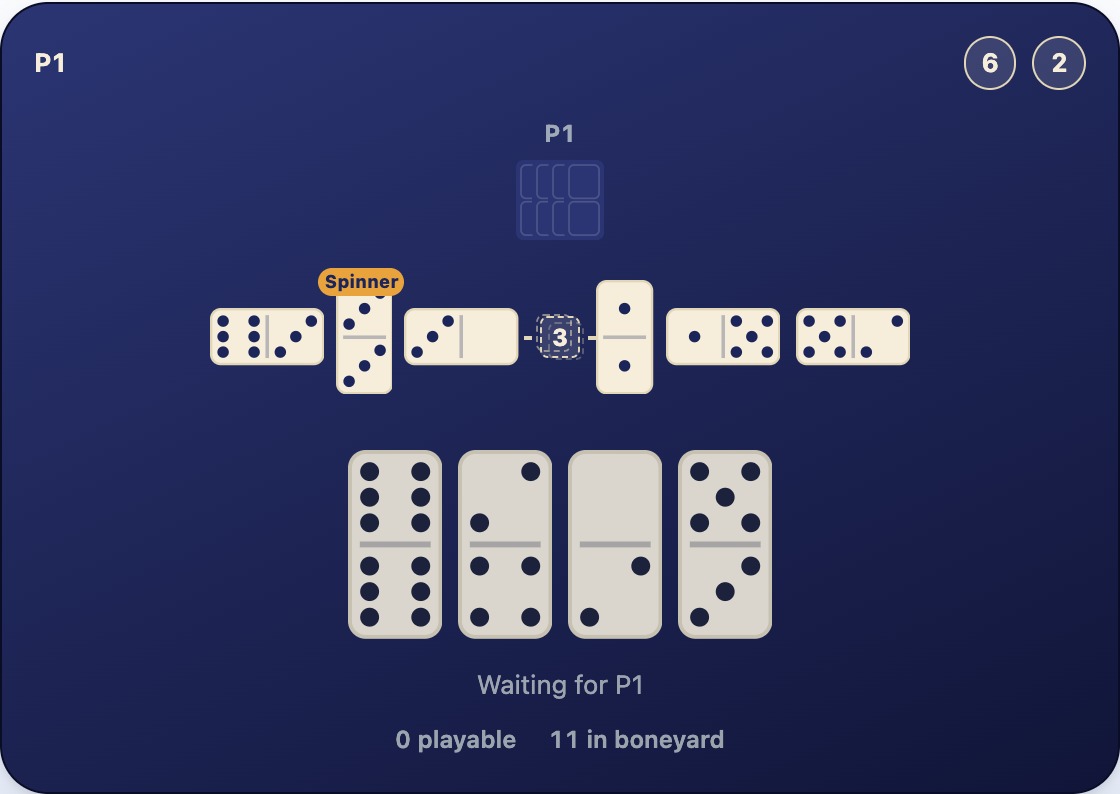
Can't match either end of the line? Draw one tile from the boneyard and check again. Keep drawing, one at a time, until you pick up something playable — then it's play as normal, same turn.
You only get to pass once the boneyard itself is empty and you still can't go. Until then, drawing isn't optional: a stuck turn always costs you at least one tile, so the boneyard shrinking is a signal everyone at the table can read — the fewer tiles left in it, the more a mismatch is going to cost the next player stuck.
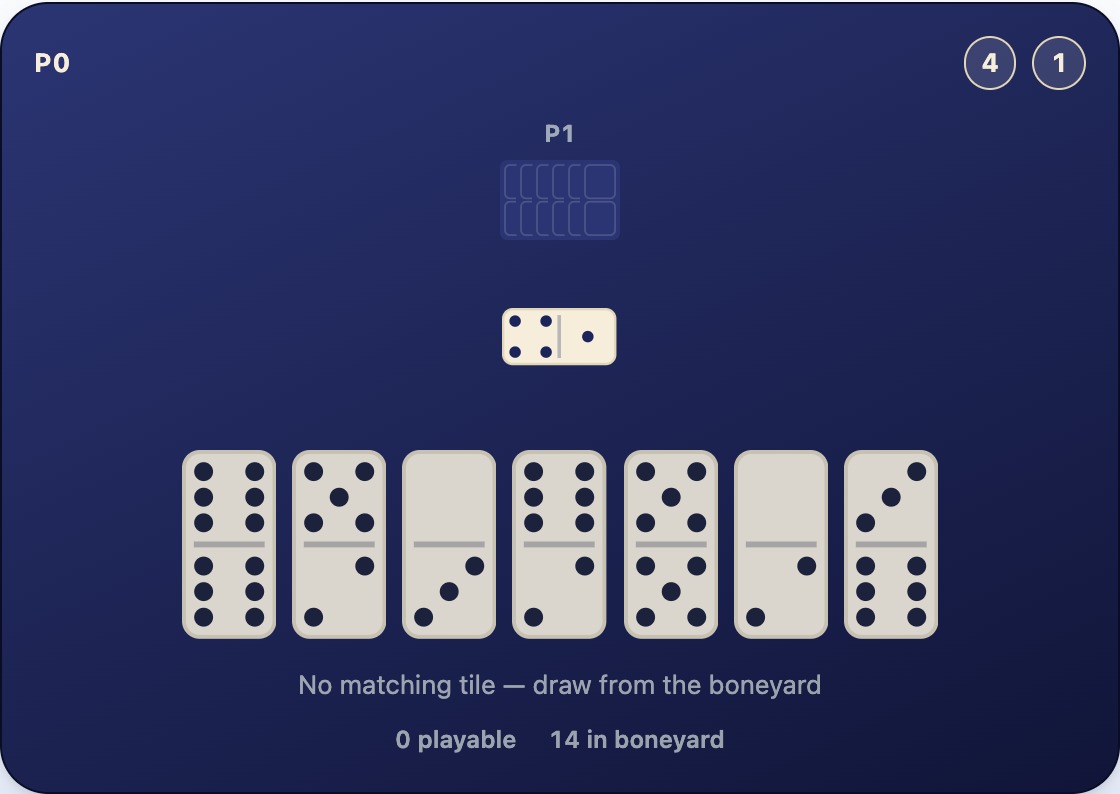
Neither of the line's open ends — 4 and 1 — appears anywhere in your hand. The boneyard still has 14 tiles in it, so you draw instead of passing.
A double plays like any other tile — it has to match an open end — but it lands turned crosswise instead of in line with the rest. That's purely visual: it still occupies one spot in the chain, with exactly one number showing at each side, same as any other tile.
The first double played in a round is sometimes called the spinner, but don't read too much into the name. Even sitting crosswise, it still has only two sides — a tile the same as the one before it, and a tile the same as the one after it. Nothing about a double branches the line. The chain that runs through it stays a single path from one open end to the other, and there are never more than two open ends at once, double or no double.
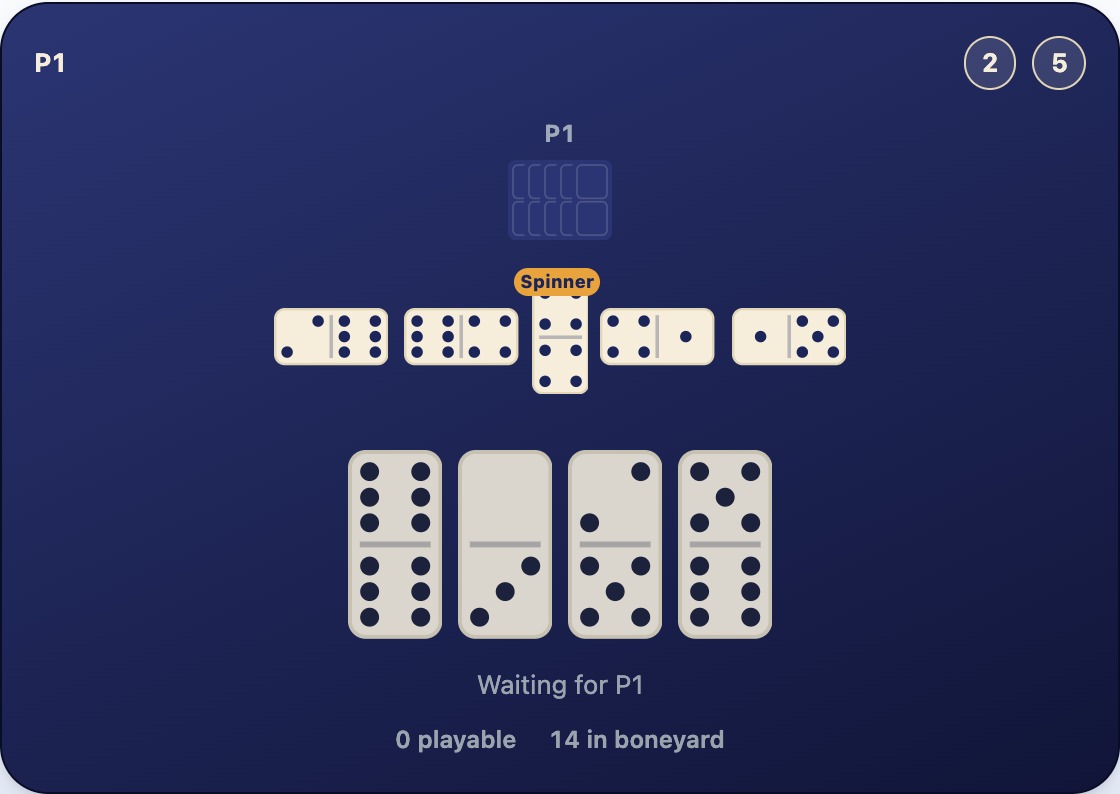
The 4-4 sits turned sideways in the middle of the line, with a tile continuing from it on the left and another continuing from it on the right. It's still just one link — the chain runs straight through.
Sometimes nobody can move. If you've drawn the boneyard down to nothing and still have no tile that fits either end, you're finally allowed to pass — the only time passing is legal.
If every player at the table passes in a row, the round is blocked and ends immediately, tiles still in hand. Nobody gets to keep drawing or waiting for a better tile; one full circuit of passes closes the round right there.
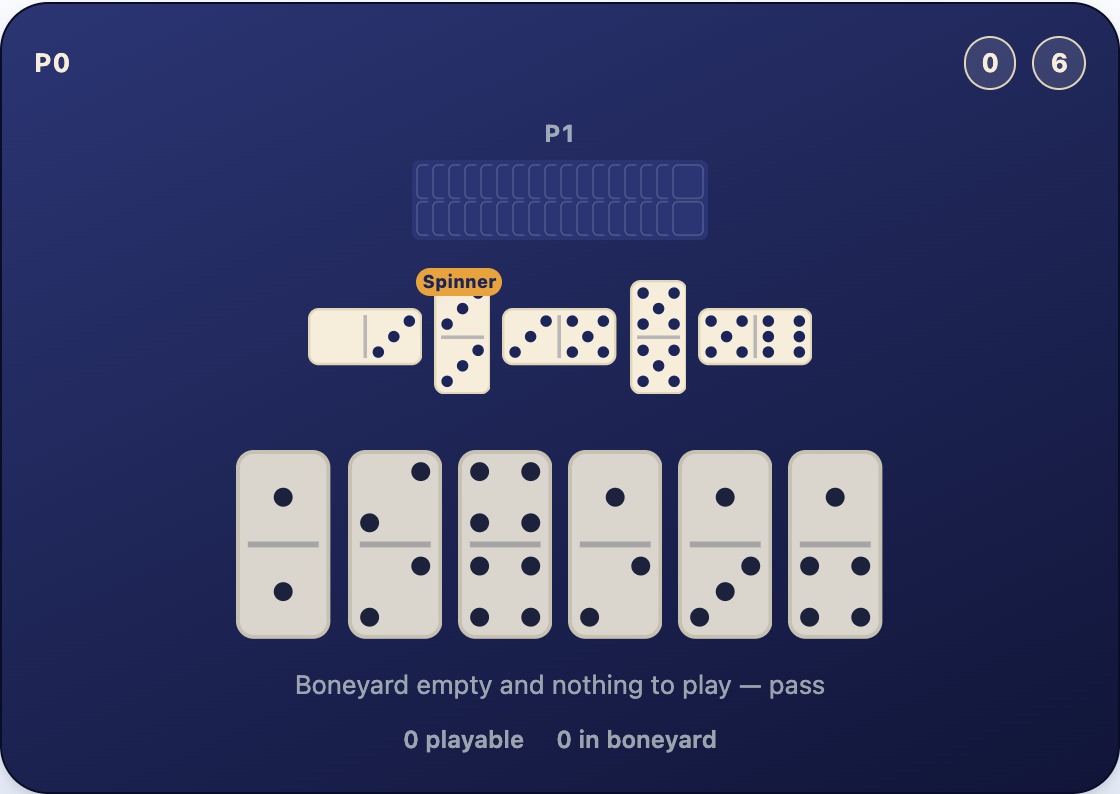
The line's open ends are 0 and 6. Nothing in your hand matches either one, and the boneyard is empty — there's genuinely nothing left to try, so you pass.
There are two ways a round can end, and they score differently.
Go out — play your last tile — and you collect every pip still sitting in every opponent's hand, added together. Get blocked instead, with nobody able to move, and it's the lightest hand at the table that scores: add up everyone else's pips, then subtract that winner's own remaining pips from the total. A tie for lightest, with the same number of tiles left too, scores nobody at all.
Either way, the points go onto a running match total. First to 100 wins the match outright, whatever round it happens on.
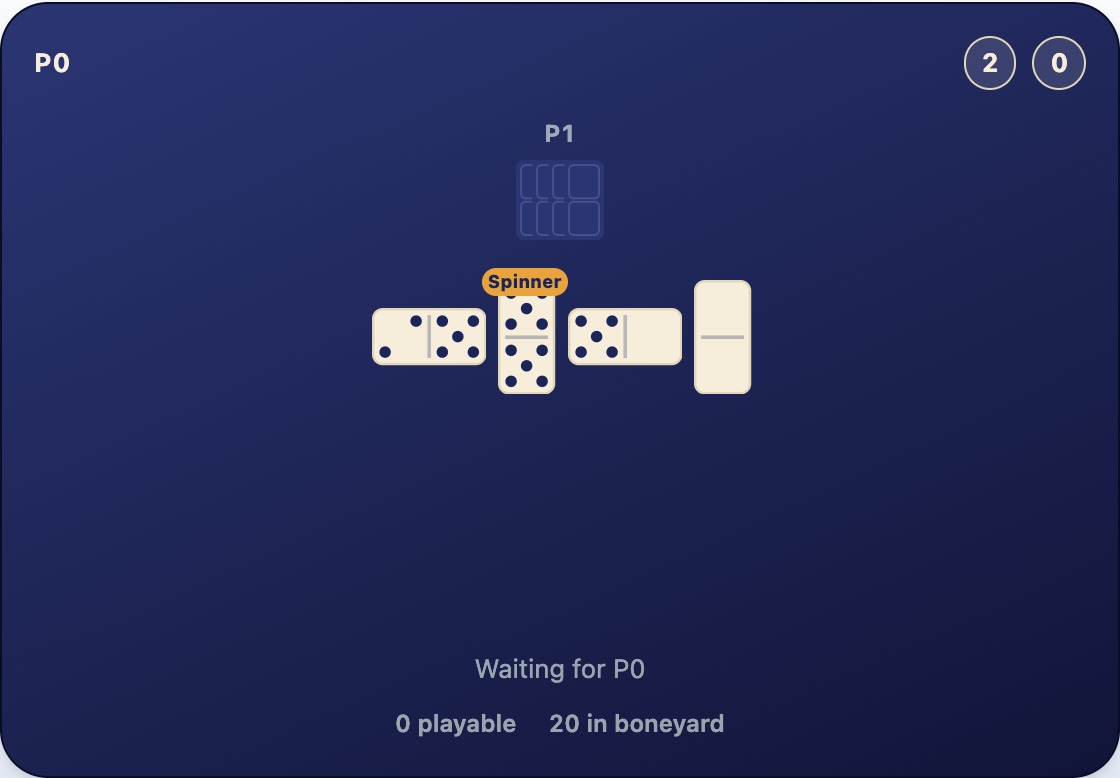
You've just played 0-0, your last tile. Your hand is empty; your opponent's isn't. Every pip they're still holding becomes your score for the round.
Count the ends, not just your own hand. Every tile that's been played is a tile that can no longer surprise you — if both 6s besides your own are already down, holding a third 6 is safe; if none are down yet, it's a gamble.
Doubles are worth unloading early rather than late. They're heavier on average (a 5-5 costs you ten pips if you're caught holding it) and they only fit one specific number, so the longer you sit on one, the more likely the line moves away from the number it needs.
Watch the boneyard, too. A shrinking pile means draws get more expensive for whoever's stuck next — if you're holding several tiles of one number, forcing a mismatch while the boneyard is small can leave an opponent drawing tile after tile while you wait comfortably with plenty left to play.
Nine tiles in, the line has wrapped onto a second row — same single chain, just folded to fit. The open ends are still only two: 6 on the left, 2 on the right. Before committing a 6 or a 2 from your hand, count how many of each are already down.