Othello Strategy for Beginners
Othello Strategy for Beginners
Othello looks simple — place a disc, flip your opponent's pieces, count up at the end. But the player with the most discs is often losing halfway through the game. This guide covers the five strategic ideas that separate beginners from players who actually win.
1. Corners Are the Most Valuable Squares
The four corners of the board are the most strategically important squares in Othello. A disc placed in a corner can never be flipped — it is surrounded on all sides by the board edge and no future move can sandwich it in a straight line.
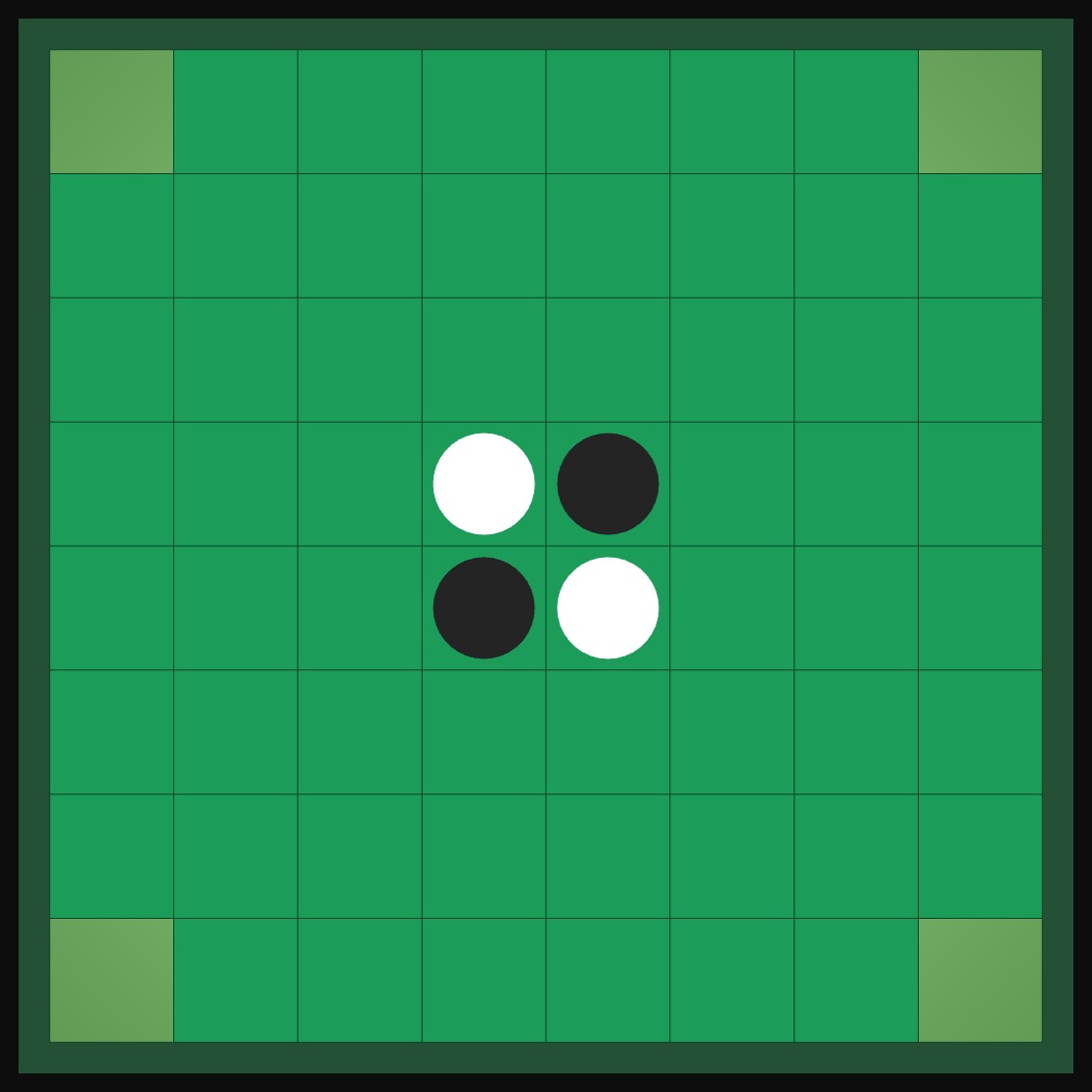
The four corners (highlighted). Capturing any one of these early is worth more than five or six discs in the centre.
Corner discs anchor stable chains along the edges. Once you own a corner and fill the adjacent edge squares, an entire row or column can become permanently yours. This is why experienced players spend the whole midgame setting up corner captures rather than racing to flip discs.
2. Avoid the X-Squares
The four diagonally adjacent squares — G2, B2, G7, and B7 — are the most dangerous squares for a beginner to occupy. They are called X-squares.
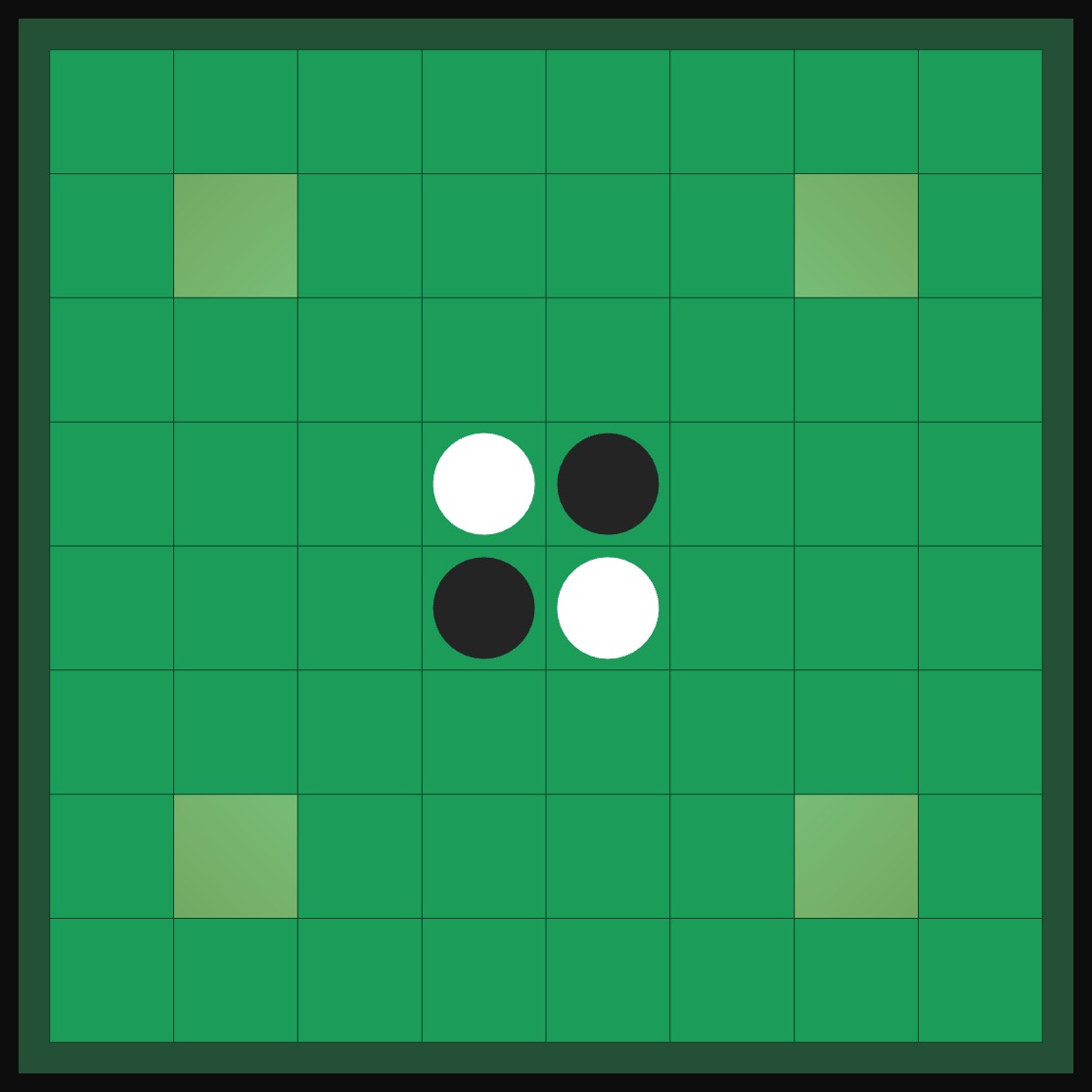
X-squares (highlighted). Occupying one usually lets your opponent take the adjacent corner on their very next move.
If you play on G2, your opponent can place on H1 — and now the corner is theirs. The disc you placed on G2 has done nothing except create the line your opponent needed to get there. Avoid X-squares in all but the most unusual late-game situations.
3. C-Squares: Handle With Care
The eight squares directly adjacent to corners along the edges — H2, G1, A2, B1, H7, G8, A7, B8 — are called C-squares. They are risky, but not automatically bad.
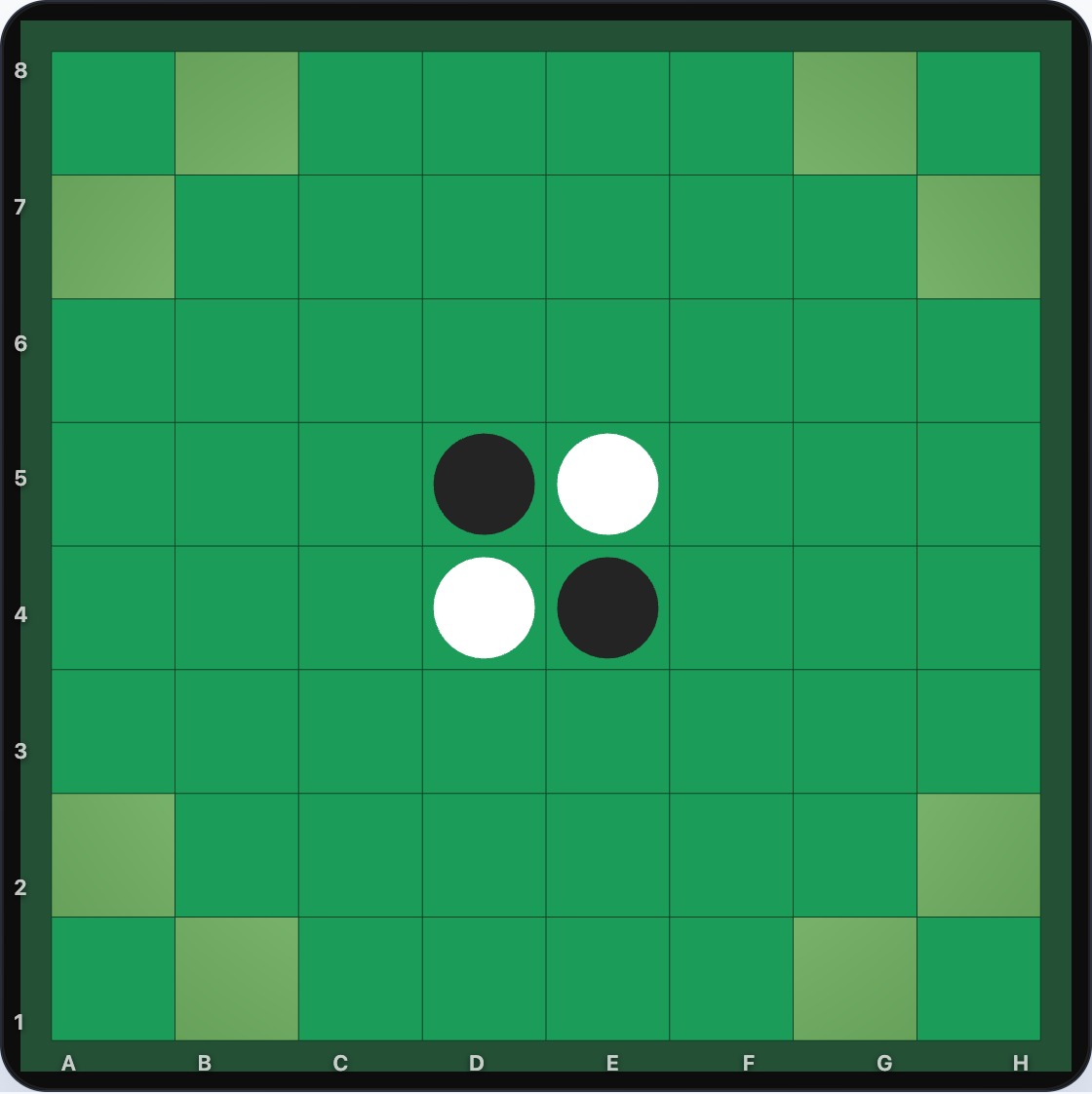
C-squares (highlighted). These edge squares next to corners can be played safely — but only if the adjacent corner is already yours, or if the opponent cannot use it to reach the corner.
A C-square disc becomes stable the moment its adjacent corner is captured by the same player. Before that point, it signals to your opponent exactly where the corner is open.
4. Mobility: Control Choices, Not Just Discs
Mobility is the number of legal moves a player has on their turn. Restricting your opponent's mobility — leaving them with very few choices — is the most reliable path to victory.
After Black opens with C4, White replies with C5, and Black plays C6, the board reaches this position. It is White's turn.
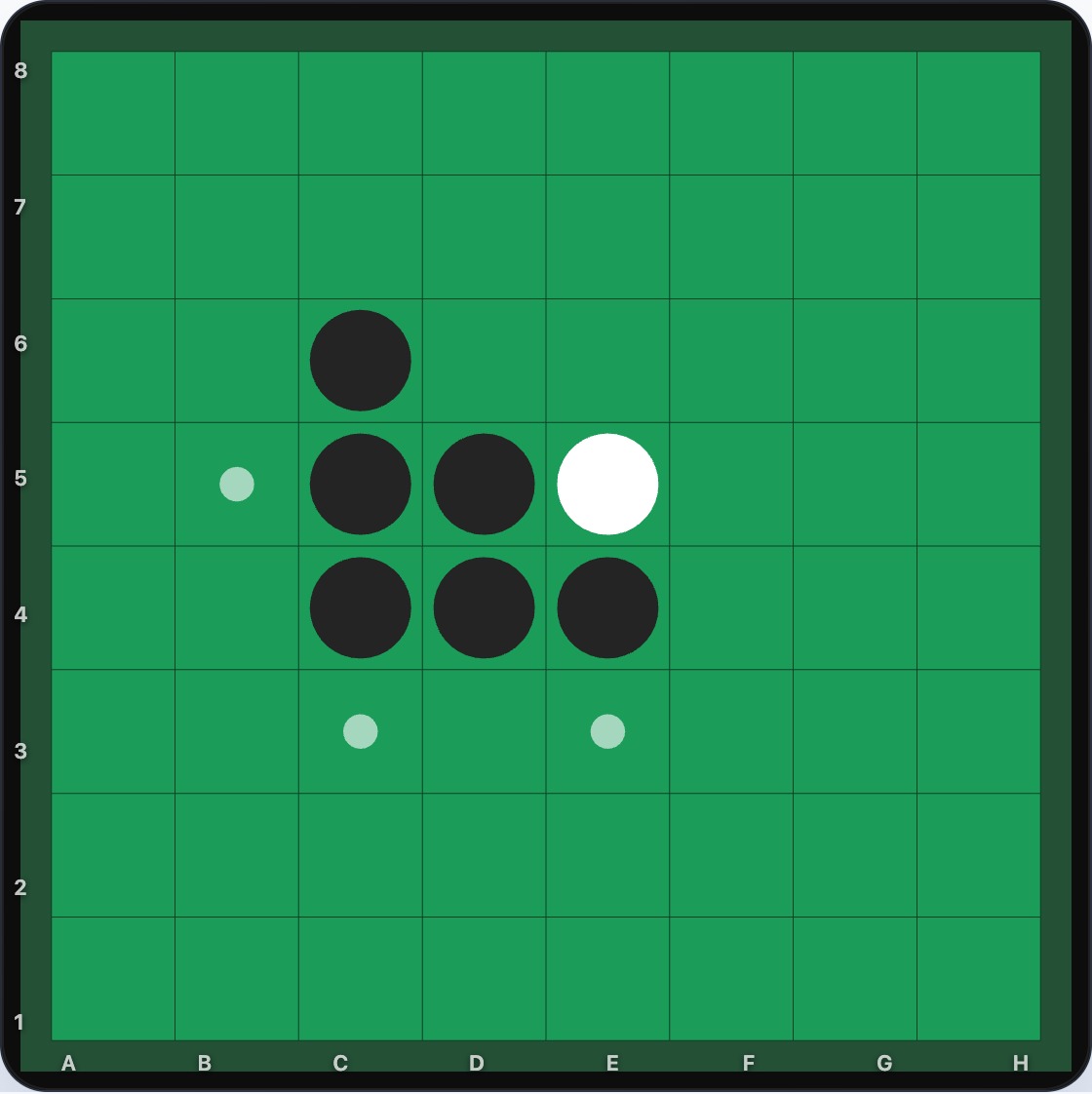
White's turn: only three legal moves are available (highlighted). Black has built a wall of six discs that severely limits White's options.
A player with few legal moves is under pressure. They may be forced to make a bad move — play on an X-square, open a corner, or create a weak edge. Keeping your opponent's mobility low is often more valuable than any individual disc flip.
5. The Disc Count Trap
Beginners instinctively try to flip as many discs as possible on every move. This is almost always the wrong strategy.
After Black plays C4, White replies C5, then Black takes E6, White plays E3, and Black plays C3 — chasing every disc flip along the way. The board looks like Black is winning comfortably.
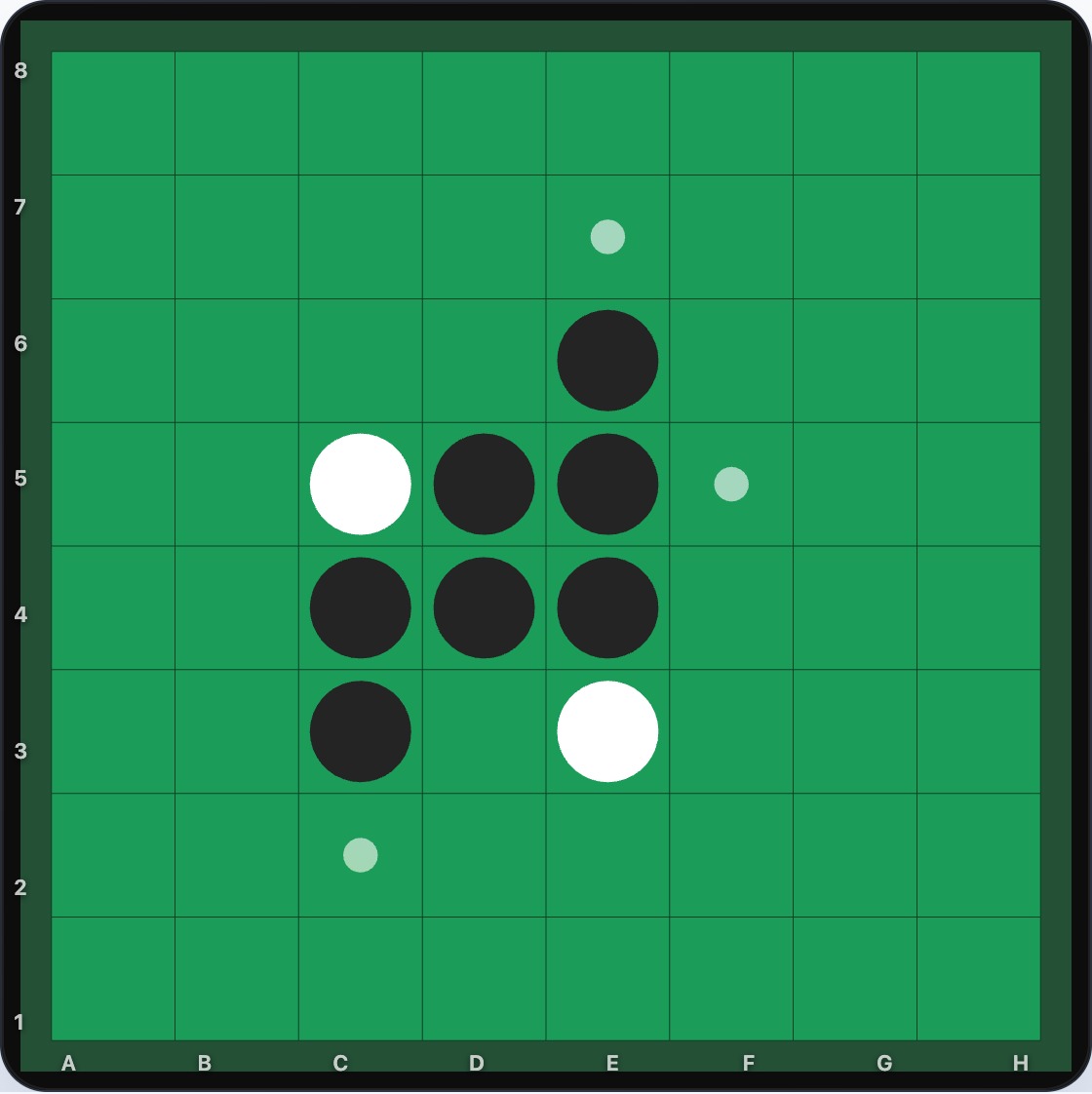
White's turn: Black leads 7–2 in discs. But all of Black's discs are exposed interior pieces. White has three moves, each of which flips a cluster of Black discs. After White plays C2, the score is immediately level at 5–5.
A large disc count in the early and middle game means your discs are spread across the board with many faces exposed. Each exposed disc is a potential flip on your opponent's next turn. Players who chase disc count often find the board flips dramatically in the last ten moves.
The disc count only matters at the very end of the game.
6. Build Stability Along the Edges
Interior discs can always be flipped from multiple directions. Edge discs can only be approached from two directions. A disc on the edge that forms an unbroken chain from a corner cannot be flipped at all.
When you capture a corner, your next priority is usually to extend along the edge in both directions. Each disc added to that chain is permanently stable and becomes a launching point for further flips.
7. The Most Common Beginner Mistakes
- Playing on X-squares. Giving your opponent a corner to chase one disc flip is never worth it.
- Counting discs at move 20. The player ahead in disc count at the halfway point often loses. Judge the game by corners, stability, and mobility instead.
- Ignoring your opponent's mobility. If your opponent has twelve legal moves and you have three, you are losing even if the disc count looks fine.
- Playing into the edges without a corner. Edge discs that do not connect to a corner can still be exploited.
- Making every move as large as possible. A small, positional move that limits your opponent is usually stronger than a large flip that leaves you with fewer future options.
Try These Ideas in a Game
The best way to develop these instincts is to play. Try Othello on Playboard — the single-player mode lets you test openings and strategies against the computer at your own pace, with no sign-up needed.
Frequently Asked Questions
- What is the most important square in Othello?
- The four corners. A disc placed in a corner can never be flipped, making it the most stable and valuable square on the board.
- What are X-squares in Othello?
- X-squares are the four diagonally adjacent squares to corners — G2, B2, G7, and B7. Playing on an X-square usually hands your opponent the adjacent corner on their next turn.
- Should I try to get the most discs in the middle of the game?
- No. Chasing disc count early is the most common beginner mistake. A large disc count in the midgame often means your discs are exposed and easy to flip. Focus on corners, edges, and keeping your opponent short of legal moves instead.
- What does mobility mean in Othello?
- Mobility is the number of legal moves available to a player on their turn. Restricting your opponent's mobility — keeping them with few choices — is one of the most reliable ways to win, more reliable than counting discs.
- Are edge squares worth taking in Othello?
- Yes, if they are stable. An edge disc connected to a corner along the same edge cannot be flipped. Unconnected edge discs, especially C-squares next to corners, can still be exploited.
- How do I get better at Othello?
- Focus on corners and mobility before disc count. Learn to recognise X-squares and C-squares and avoid giving them away. Play against the computer on Playboard to test ideas at your own pace.